Nath promises overhaul of road & highway sector
May 30, 2009
In what could be seen as strong indications of an overhaul in the working of road transport and highway sector, new minister Kamal Nath on Friday made it clear that he would go for wholesome changes in the ministry to put road construction back in top gear.
After taking charge of the ministry, Nath said his focus would be on implementation of projects on the ground rather than making big plans — a clear indication that the sector will get a major boost.
“Sadkon ko napi jaati hai, plans ko nahin (roads are measured and not the plans). Lot of thought has been given to planning in the past two years. Now we have to deliver. Performance is evaluated on the basis of kilometres of roads that are built. Now our agenda is of change. The system has to be overhauled so that work on the ground happens. Planning has to be delivered on roads,” he told reporters.
Nath, who was shifted from commerce and industry to road transport and highways, said he was “excited” about his new portfolio. He said he was looking forward to a challenge and he had got one.
On highway projects under public private partnership (PPP) model finding lukewarm response from private developers, the minister said, “Models which are not working have to be done away with and we need to adopt models which can attract investors. Moreover, just awarding the work is not just enough. We have to ensure progress is made on the ground.”
Spelling out his approach to bring the key infrastructure sector back on track, the minister said he was looking at structural changes in the system and procedures to make it result oriented. “Some of the old regulatory frameworks relating to transportation like multiple permit and Motor Vehicles Act have to be looked at from new perspectives. Old laws have to be amended,” he said.
Ministers of state Mahadev Khandela and R P N Singh also assumed charge on Friday.
Source: timesofindia.indiatimes.com
Nath promises action on roads
May 30, 2009
Once the high-profile commerce minister making India’s voice heard at global trade fora, Kamal Nath is now tasked with putting the country’s teetering highway projects on track. The surface transport ministry had drawn criticism for slippage in project implementation and delay in awarding contracts , but the new minister says actions will speak for themselves . Excerpts from an interview:
What will be the key focus areas of the new government?
In the past, there has been enough planning. Now thoughts have to be transformed into action. We have to ensure that the system and platforms are workable. Performance has to be measured not in terms of plans, but actual work. Things have to be looked at in a new way. In a few weeks, a new model will be found so that India can build the highest number of road kilometres. We have to see that all the outlays are utilised. A successful plan is that which is converted into action.
There have been talks of roads as a stimulus to the economy…
The greater the outlay on construction of roads, the greater the impetus to the economy. If you look at the development of countries like China, Japan and those in Europe, it is all based on their roads and other major infrastructure. There could be better airports but without good roads it doesn’t help much. Along with highways, rural roads too have to be given proper attention.
Earlier, there were delays on the part of the government… but a big hurdle was the paucity of cash owing to the impacts of the financial slowdown, which too delayed project implementation…
We will meet all the states in a month’s time to remove the bottlenecks . Some old regulatory frameworks on transportation such as multiple permit and others have to be reviewed . We are looking at new models . We will look at new ways of capital inflow.
Source: economictimes.com
Govt needs to overhaul road infra regulations – Kamal Nath
May 30, 2009
India needs to rework its regulatory policy framework for road infrastructure, the new transport minister said on Friday, as the government looks at the sector to boost growth in a flagging economy. “Old regulatory framework needs to be looked in a new way,” Transport Minister Kamal Nath told a news conference.
India’s economy slowed to a six-year low of 6.7 percent in the year to March 2009, and many expect it to slow further to 6 percent in the current fiscal year, compared with 9 percent or more in the recent past.
Source: in.reuters.com
Old framework for transportation sector to be modernised: Nath
May 30, 2009
The “old regulatory framework” relating to the transportation sector will be modernised to make it “practical”, Minister for Roads Transport and Highways Kamal Nath said today.
“Some of the very old regulatory frameworks we have relating to transportation like multiple permit and others have to be looked at (anew)… We are looking at new models,” Nath told reporters here while taking charge of the Ministry.
He also said that the outlay for constructing roads and highways has to be utilised and the programmes and mechanisms for road development have to be made workable and practical.
Nath, who was Minister for Commerce and Industry in the previous Government, said he will work towards meeting the challenge of providing stimulus to the economy through developing roads and highways.
“With the current global recession and the (slowdown) in the country, it is important that this (development of roads and highways) provides economic stimulus, this provides jobs and this is going to the biggest challenge,” he said.
His ministry will also look at the impediments in implementing plans for infrastructure development in the country, Nath said.
Source: business-standard.com
Kapsch TrafficCom delivers 30,000 transponder units for the Eazy Pass electronic toll system in Ireland
September 12, 2008
Kapsch TrafficCom AG has secured an order for the first Eazy Pass electronic toll system in Dublin. The company has satisfied the particularly demanding criteria of Eazy Pass and is to supply 30,000 transponder units (or tags for short) to Ireland. Eazy Pass will be used on the new M50 toll route in Dublin. The system will also allow barrier-free driving throughout Ireland. Eazy Pass enables electronic payment at all Irish toll stations, without the need to stop.
The latest order for Kapsch TrafficCom comes from Ireland. The Kapsch TrafficCom subsidiary Kapsch TrafficCom Ltd. is to supply 30,000 transponder units to Dublin. These will be used in the first electronic toll system Eazy Pass on the new M50 toll route in Dublin. Eazy Pass is now also accepted on the N4/N6 Kilcock-Kinnegad, N8 Fermoy Bypass, Dublin Port Tunnel, East-Link and M1 Dundalk Western Bypass. Within the scope of this order, Kapsch will supply transponder units for passenger cars and tags for goods vehicles.
“We have worked with Kapsch TrafficCom since we pioneered electronic tolling in Ireland. Kapsch is our principle technology supplier and a real key partner. We are therefore very pleased that Kapsch TrafficCom has been able to meet our requirements in order to support us in what is a particularly important step towards the expansion of electronic tolling in Ireland,” explains Dermot MacEvilly, CEO of Eazy Pass.
Vienna, 12th September 2008
For further information:
Brigitte Herdlicka
Public Relations & Sponsoring
Kapsch Group
Phone: +43 (0) 50 811 1705
A-1120 Vienna, Wagenseilgasse 1
E-mail: [email protected]
www.kapschtraffic.com
www.kapsch.net
Kapsch TrafficCom delivers Toll Systems for Urban Motorways in Bangkok
September 4, 2008
Kapsch TrafficCom impresses yet again with a new project in Asia: The company is constructing modern toll systems for three of the largest motorways in Bangkok. Kapsch TrafficCom Sweden will be working with two Thai companies under the joint venture FKS. The order for more than 55 kilometres of motorway in total will be completed in August 2009. Its worth is estimated at 8.5 million euros.
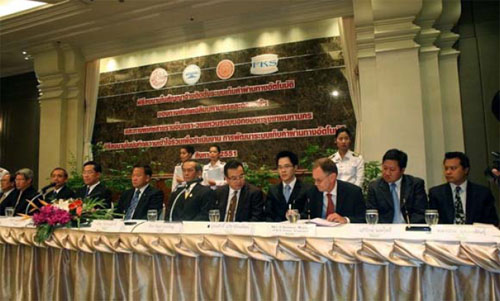
(Signing of contract – Christer Weiner, Kapsch TrafficCom Sweden, together with the Thai partners and customers)
As from autumn 2009, visitors to Bangkok will be escorted on their journey into the centre of the city by Austrian toll equipment. For Kapsch TrafficCom was able to notch up an order recently to fit out three large motorways in Bangkok. More specifically, the company will install the system by order of the Expressway & Rapid Transit Authority of Thailand (EXAT), in cooperation with the two Thai companies Fatima Group and Smart Traffic Co Ltd – as FKS Joint Venture. The Chalerm Maha Nakhon Expressway (consisting of three sections with a total length of 27.1 kilometres), the Chalong Rat Expressway (six-lane with a length of 18.7 km) and the Ramindra Outer Ring Project (with a total length of 9.5 kilometres) are set to be equipped with toll systems.
“Kapsch TrafficCom has repeatedly been successful in Asia. By replacing the 8-year old equipment and upgrading the electronic toll system, the flow of traffic on these three motorways will be sped up and traffic jams will to a large extent be avoided. This was possible primarily because of the extensive expertise of our employees and due to our many years of experience on the Asian market”, declares Erwin Toplak, Member of the Board, Kapsch TrafficCom AG.
The contract to set up the largest electronic toll system to date and a central system for registering and guiding traffic comprises altogether 80 lanes. The new infrastructure will include 100,000 CEN DSRC compatible transponders, 100,000 non-contact smart cards and other equipment (i.a. server equipment, a network and a CCTV video camera system). The system will be completed in autumn 2009 and comprises an order volume of approximately 8.5 million euros.
Kapsch TrafficCom is an international supplier of innovative road traffic telematics solutions. Its principle business is the development and supply of electronic toll collection (ETC) systems, in particular for the multi-lane free-flow (MLFF) of the traffic, and the technical and commercial operation of such systems. Kapsch TrafficCom also supplies traffic management systems, with a focus on road safety and traffic control, and electronic access systems and parking management. With more than 140 reference projects in 30 countries in Europe, Australia, Latin America, in the Asian/Pacific region and in South Africa, and with almost 12 million on-board units (OBUs) and nearly 11,000 equipped lanes, Kapsch TrafficCom has positioned itself among the leading suppliers of ETC systems worldwide. Kapsch TrafficCom is headquartered in Vienna, Austria, and has subsidiaries and representative offices in 20 countries.
For further information:
Brigitte Herdlicka
Public Relations & Sponsoring
Kapsch Group
Phone: +43 (0) 50 811 1705
A-1120 Vienna, Wagenseilgasse 1
E-mail: [email protected]
www.kapschtraffic.com
www.kapsch.net
LANCO bags two toll road projects in Karnataka
August 4, 2008
LANCO Kondapalli Power Pvt Ltd, a subsidiary of LANCO Infratech Ltd, has bagged the contract for construction and operation of two road projects in Karnataka on Build, Operate and Transfer (BOT) basis under the National Highways Development Project (NHDP) Phase III.
The company has formed two Special Purpose Vehicles (SPVs) – LANCO Hoskote Highways Pvt Ltd and LANCO Devihalli Highways Pvt Ltd for undertaking the projects. The concession agreements for the projects have been signed with the National Highways Authority Ltd. The two road projects are the 81 km Bangalore-Hoskote-Mudbagal stretch on National Highway 4 and 82 km Neelamangla – Devihalli stretch on National Highway 48. The project involves six laning of 16 km stretch and four laning of the remaining stretches. The total project cost is estimated at Rs 1,006 crore. The concession periods are 20 and 25 years for the two projects respectively, including 30 months of construction period. The contracts have been awarded through a competitive bidding process.
LANCO Group is one of the fastest growing corporate entities in India. LANCO has more than two decades of experience operating in the core sectors of Power Generation, Power Trading, Realty, Engineering and Construction, Information Technology and Manufacturing. At present, the power portfolio includes an operating capacity of 518 MW and additional capacities under construction aggregating to more than 3,200 MW. The Construction and EPC division of the company is executing various orders worth more than Rs 7,500 crore. LANCO is also developing LANCO Hills, one of the largest integrated township properties in Hyderabad, which will have a developed area of more than 30 million square feet and one of the tallest residential towers in the world. The development of the property is estimated to cost Rs 5,500 crore.
Source: moneycontrol.com
Bid to widen highway begins
August 4, 2008
Ranchi, Aug. 1: National Highways Authority of India (NHAI) has set the ball rolling for the four-laning of Hazaribagh-Ranchi stretch of NH-33, considered to be the lifeline of Jharkhand.
NHAI, which functions under the Union ministry of road transport and highways, has invited a global expression of interest (called request for qualification in technical parlance) from construction majors. The last date to respond is August 29.
“It would be a 75km stretch of NH-33 costing around Rs 600 crore. The tenders would be on build, operate, transfer (BOT) annuity basis,” said H.C. Arora, the chief general manager of NHAI, who looks after projects in Uttar Pradesh, Uttarakhand, Bengal, Bihar, Jharkhand and Delhi.
This would be the third time that NHAI has invited tenders for the same stretch.
Earlier, two efforts to finalise the project through BOT-toll basis proved futile with no parties responding to pre-qualification bids apparently due to Naxalism and law and order problems in the state. Under BOT-toll, the contractors awarded works are supposed to invest the entire project cost and realise the same by collecting toll taxes for the next 30 years or so.
Under the annuity basis, although the construction company would invest the entire project cost, a fixed annual sum as annuity from the government would ensure that the former gets back its invested money.
In a related development, the ministry is contemplating to turn the 150-km stretch of NH-33 between Ranchi and Jamshedpur into a single package. Earlier, the stretch was divided into two packages — one between Ranchi and Rargaon and the other between Rargaon and Mohulia.
Arora added that the NHAI would soon invite expressions of interest for the Ranchi-Jamshedpur stretch, too.
The ministry was in favour of inviting the tenders on BOT-toll basis. The overall cost of the project would be around Rs 1,300-1,400 crore.
The proposed Hazaribagh-Ranchi four-lane road would end near Vikas Vidyalaya by taking a bypass of about 20km before meeting Ranchi-Jamshedpur highway near Rampur.
The state and central authorities are discussing whether the proposed Ring Road project for Ranchi can be merged with the highways’ proposed bypass on a cost-sharing basis. Arora added that the four-laning project of both the stretches would be part of National Highway Development Programme-Phase III.
Source: telegraphindia.com
Gammon India Ltd sees FY09 topline at Rs 3K cr
August 2, 2008
Gammon India has declared its results for the quarter ended June 2008 (Q1). The company’s standalone net sales were at Rs 585.24 crore versus Rs 540.31 crore.
 Parvez Umrigar , MD, Gammon Infrastructure Projects said that Gammon India Limited, the contracting arm of the company will book a topline turnover of Rs 3,000 crore for the current year. He added that Gammon Infrastructure, the development arm is more of a value based play and they have capital investment plans of around Rs 7,500 crore scattered over the next few years.
Excerpts from CNBC-TV18’s exclusive interview with Parvez Umrigar:
Q: Numbers look good, Operating profits margins stood at about 71%, the key concern right now is whether are not incremental orders are expected to slow down and more importantly for the current order book that you enjoy at Rs 9,500 crore is there an issue on execution?
A: The privatization space across the sectors continues to keep pace and infact the government has given us a choice that would like to promote more on a privatization model.
We have had some slow down in the road sector because the implementation under NHI new model agreement have had some issues raised by some developers and that once in a while you do change a model agreement so those things arise but otherwise if you see the action in BOT (Build, Operate, Transfer) space for example the government just announced the qualifications of Ennore.
Q: So out of the Rs 9,500 crore of order book, how much execution will be possible in this year and the incremental orders that are coming in, what is the average size that you are looking to bid right now?
A: Gammon India Limited, the contracting arm will book a topline turnover of Rs 3,000 crore for the current year. Gammon Infrastructure, the development arm is more of a value based play and they have capital investment plans of around Rs 7,500 crore scattered over the next few years.
Q: We understand you have 14 projects underway, what is the kind of outlay for these projects?
A: The 14 Special Purpose Vehicles (SPV) companies that we have has an overall capital outlay of Rs 7,000 crore which would involve an equity investment of Gammon itself of around Rs 500 crore.
Q: What is the overall target for FY09 for Gammon Infrastructure at this point in time and what are the kinds of projects you are bidding for right now?
A: Gammon Infrastructure for the current year we expect to grow our current 14 SPVs by at least four more, there two SPVs where we are lowest in the bid and we await the letter of intent (LOI) ending which we can make the official announcement. The topline for the current year on a turnover basis will be around Rs 250 crore.
Source: moneycontrol.com
ATTSII Recommends Guidelines For A Suitable Electronic Toll Collection Standardisation For India
July 31, 2008
PROPOSES WORLD WIDE TESTED AND RECOGNIZED CEN 278, BASED ON DSRC MICROWAVE TECHNLOGY
New Delhi, 23rd July, 2008: The Association of Toll and Traffic Systems Integrators of India (ATTSII) has recommended guidelines for a suitable Electronic Toll Collection (ETC) to the working group formed by the Committee of Road Safety and Traffic Management, Ministry of Surface Transport and Highways to determine the technology for Advance Traffic Management Systems, Advance Travel or Information Systems and Electronic Toll collection Systems. The association proposes CEN 278 standard based on DSRC (Dedicated Short Range Communication) microwave technology for the Indian subcontinent keeping in mind the Indian environment and driving conditions.
Representing the association, Mr. Sachin Bhatia, President ATTSII and Country Director of KAPSCH METRO JV said, “CEN 278 is the most acceptable technology worldwide with interoperability standards. It is already successfully implemented at the Delhi – Gurgaon Expressway, the largest 32 lane toll plaza in India. Introduction of smart tags based on microwave technology has received overwhelming response from drivers who earlier had to wait in long queues for several hours at the Toll. Now, it only takes few seconds for each vehicle to pass through, significantly reducing waiting time. CEN 278 is a cost effective technology as multiple vendors are present in the market to ensure that customers get the best competitive deal.
“At a time when India is starting to put in place the ETC technology, it should adopt the most advanced technology that is pre tested, allows wider applications and faster data transfer speed. We cannot afford to lose time in deciding on a technology as there is an urgent need to meet the ever increasing traffic management requirements in India that suits the masses and is most viable to implement,” said Mr. Aman Kishore ,VP of the ATTSII and Managing Director of International Road Dynamics (IRD) South Asia.
“IRD have successfully implemented CEN 278 standard microwave based Electronic Toll Collection(ETC) technology in April 2006 at Hoogly River Bridge Commissioners (HRBC) site at Vidyasagar Setu – Kolkata. HRBC is a West Bengal Government organization for operation, implementation and maintenance of Hoogly Bridge. Currently, it has 24 lanes at 1 Plaza with 4 ETC Lanes and is efficiently meeting requirements of the department to cater to heavy traffic volumes in a matter of seconds at the entry to Kolkata city,” added Mr. Kishore.
He further explained, “Most of the Build Operate Transfer (BOT) operators are opting for technology for ETC which is more cost effective and operationally efficient for Indian conditions. Recently, we have bagged an order for implementation of CEN 278 standard microwave based ETC from one of biggest BOT and O&M operators in the country – Ideal Road Builders (IRB), Mumbai for one of its locations at Mumbai’s Entry Points. The decision of opting for Microwave based ETC technology by such a reputed company must have been taken after much due diligence.”
“The major advantage of the microwave technology is the presence of numerous vendors in the market that generates fair competition. We must understand the emerging traffic volume in our country and we must opt and guide for technology which best meets diverse user needs and national interest, rather than being guided by commercial interest of vendors.
“CEN 278 standard is based on microwave technology, making it more reliable, robust and viable. A very recent example is the stormy morning of 14th May; any other known standards based on other technologies like infrared would have created chaos at points where it would have been applied. This is because in dusty weather, data fails to be securely transmitted, resulting in distortion in reporting and further leading to revenue leakages at tolling booths. As ATTSII represents the road operators in India, we sincerely hope to provide the best infrastructure and cost effective method of ETC for the end benefits for our people, we strongly recommend CEN 278 to be included as a policy due to its advantages outweighing that of any other present technology, pre -tested and widely accepted”, further explained Mr. Bhatia.
“It is a proven technology being used for electronic toll collection for many years around the world. This proves also our more than 140 reference projects in 30 countries in the Asian/Pacific region, Europe, Australia, Latin America and in South Africa. This technology guarantees thanks the reliability of the tolling system and the low error rate the maximum toll income and it is the perfect choice for charging on motorways, expressways and even secondary main roads. With respect to interoperability the DSRC is the only working technology today providing the necessary standards and specifications. We have also already made very good experiences with using of the DSRC tolling systems for the improving of the road safety and for the optimizing of the traffic flow by the installation of traffic data sensors or variable message signs on the toll gantries,” said Erwin Toplak, Management Board, Kapsch TrafficCom AG.
About ATTSII
The Association of Toll and Traffic Systems Integrators of India (ATTSII) has been established in India for the Toll and traffic Industry players to share their views; ideas and technologies through a common platform. The Association comprises of the leading players of the Industry as below:
- IRD, Canada / India
- Kapsch TrafficCom AG; Austria/ India
- GEA; France / India
- CS ROUTE ; France/ India
- Metro Road Systems ; India
- Q-Free / Comvision , India
About Kapsch TrafficCom AG
Kapsch TrafficCom AG is an international supplier of innovative road traffic telematics solutions. Its principle business is the development and supply of electronic toll collection (ETC) systems, in particular for the multi-lane free-flow (MLFF) of the traffic, and the technical and commercial operation of such systems. Kapsch TrafficCom also supplies traffic management systems, with a focus on road safety and traffic control, and electronic access systems and parking management. With more than 140 reference projects in 30 countries in Europe, Australia, Latin America, in the Asian/Pacific region and in South Africa, and with almost 12 million on-board units (OBUs) and nearly 11,000 equipped lanes, Kapsch TrafficCom has positioned itself among the leading suppliers of ETC systems worldwide. Kapsch TrafficCom is headquartered in Vienna, Austria, and has subsidiaries and representative offices in 20 countries.
For further media queries contact:
Alka Ohja / Archana Sharda
Blue Lotus PR
[email protected] / [email protected]
011-46571241 / 42
9958443490 / 9811838332
Featured Insights
- Gurugram: Hero Honda chowk to not choke anymore as Delhi-Jaipur flyover set to open soon
- Future of extensive Smart City projects uncertain
- Financiers express interest for Mumbai-Nagpur super expressway
- Indian start-ups to double by 2020: Nasscom
- SBI inks pact with IIT-Kharagpur for fintech innovation
- Supreme Court refuses to stay Allahabad HC order of making DND fly-way toll-free
- An analysis by CRISIL on the pace of road construction
- Mumbai University gives way for better connectivity at BKC
- Debit card scare: A lesson for banks and their customers
- What is a Smart City ?

The ITW Team
 Sachin Bhatia Chief Editor |


Leisure
E-Z Pass Only
Improved Car Seat Belt 40% Less Accidents

NHAI's First ETC(Electronic Toll Collection) PLAZA
- ETC based on Microwave Technology(CEN 278) implemented at Delhi - Gurgaon Super Connectivity
Technology by: -Kapsch Metro JV.
News Categories
- NHAI (332)
- Highway (233)
- BOT (231)
- Projects (207)
- Default (204)
- Road (182)
- About (175)
- Infrastructure (160)
- Tolling (108)
- Investment and Finance (102)
- Expressway (98)
- Construction (90)
- Smart City (87)
- NHDP (77)
- ITS (65)
- International (55)
- Delhi (53)
- Safety (53)
- Toll Plaza (51)
- Toll Management System (50)