Govt allocates Rs 37,880 cr for NHAI; sets a target of constructing 8,500 km of highways.
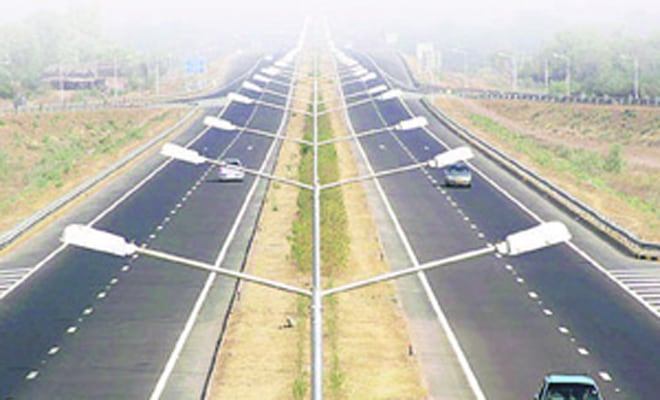
The road sector got a major boost on Thursday as the government announced it would invest Rs 37,880 crore for the National Highways Authority of India (NHAI) and set a target of constructing 8,500 km of highways in the current financial year.
In his budget speech, Finance Minister Arun Jaitley said steps would be taken to encourage the private sector to partner with the government in executing big-ticket infrastructure projects. As a key step, he said, an institution called 3P India would be set up with a corpus of Rs 500 crore to help execute public private partnership (PPP) projects. For project preparation, NHAI would set aside Rs 500 crore, he said.
Setting an ambitious target of constructing 8,500 km of highways this fiscal, Jaitley said of the Rs 37,880 crore to be invested for highways, Rs 3,000 crore would be spent in the Northeast alone. He announced initiation of work on select expressways in parallel to the development of industrial corridors.
Jaitley said India has emerged as the largest PPP market in the world with over 900 projects in various stages of development. PPPs have delivered some iconic infrastructure like airports, ports and highways, which are seen as models for development globally. But considering the weaknesses of the PPP framework and rigidities in contractual arrangements, there is a need to develop more nuanced and sophisticated models of contracting and develop quick dispute redressal mechanism.
Stating that the Pradhan Mantri Gram Sadak Yojana, which began under the tenure of NDA-1, “had a massive impact” in improving access for the rural population, Jaitley said, “It is time to reaffirm our commitment to a better and more energetic PMGSY under the dynamic leadership of Prime Minister Narendra Modi. I propose to provide a sum of Rs 14,389 crore.”
After a dismal show in 2012-13, the Union Road Transport Ministry had scaled down its projects award target by nearly half to 5,000 km 2013-14. It could award less than 2,000 km projects in 2013-14. In 2012-13, the ministry was barely able to award 15 per cent of the targeted 9,500 km of highways on account of a number of factors, including delay in clearances and equity crunch by developers.
“The road sector constitutes a very important artery of communication in the country. The sector had taken shape from 1998-2004 under NDA-I. The sector again needs huge amount of investment along with debottlenecking from maze of clearances,” Jaitley said.
Arguing that metro projects have helped in de-congesting cities, he said Rs 100 crore has been earmarked in the budget for metro projects in Lucknow and Ahmedabad.
A National Industrial Corridor Authority, to be headquartered in Pune, would be set up with a corpus of Rs 100 crore to coordinate the development of the industrial corridors, with smart cities linked to transport connectivity, he said.
Saying development of ports is critical to trade, he said 16 new port projects are proposed this year. He announced allocation of Rs 11,635 crore for development of outer harbour project in Tuticorin for phase I.
Jaitley announced a new scheme to develop airports through PPP and hiked allocation for the Civil Aviation sector by over 11.4 per cent to Rs 9,474 crore.
The highways ministry expects projects worth over Rs 1 lakh crore, which have been stuck for long, to start moving from next month as a concrete decision on the rescheduling of premium paid by developers is expected by the end of this month.
“I am hopeful that highway projects worth over Rs 1 lakh crore would be on stream next month onwards. The report of C Rangarajan Committee on premium rescheduling is likely to be accepted by month-end,” road transport and highways minister Oscar Fernandes told PTI.
The government has constituted a panel, headed by Prime Minister’s Economic Advisory Council C Rangarajan, to look into the issues pertaining to bailout of highway developers. The government had approved a proposal in October for the postponement of premium payments by highway developers and has referred the matter to the Rangarajan panel.
The move is likely to provide relief to a large number of players such as GMR, GVK and Ashoka Buildcon.
Their projects have been facing delays on account of high premium — the payment made by developers to the National Highways Authority of India under the BOT mode.
The premium, which is offered by companies during the bidding stage, is based on projected returns from tolls.
Higher Education Minister R V Deshapande and Chief Minister Siddaramaiah with Union Minister Kamal Nath in New Delhi on Monday
Chief Minister Siddaramaiah, who is on a two-day visit to Delhi, met Union Urban Development Minister Kamal Nath on Monday and sought funds for various highway projects being undertaken in the state.
According to official sources, during Siddaramaiah’s over half-an-hour meeting with the Union minister he submitted a memorandum on the projects which were being taken up in the state under the Jawaharlal Nehru National Urban Renewal Mission (JnNURM) and National Highways Authority of India (NHAI).
He also met Union Health Minister Gulam Nabi Azad and conveyed concerns of the arecanut farmers following an affidavit submitted by the Health Ministry to the Supreme Court supporting the ban on areca.
Later, Siddaramaiah told reporters that the Centre has not submitted any affidavit suggesting the SC to impose ban on the use of arecanut.
“We also brought to the notice of the Union Health Minister the medicinal properties of areca,” he said.
Higher Education Minister R V Deshapande, Urban Development Minister Vinay Kumar Sorake, Congress MPs H Vishwanath and R Dhruvanarayan and MLAs S R Mahesh and Chikkamadu were also present.
Proposal to cut the target of contracting out 4,028km of highway projects to be placed at a review meeting today
Ragini Verma
The roads ministry awarded just 1,322km of road projects in 2012-13 against a target of 9,500km. Photo: Mint
New Delhi: India’s roads ministry has nearly halved its target of awarding highway projects to 2,128km in the year to March because developers are not showing interest in bidding for many of these. “There is no interest from the private sector and the slowdown is severe on the PPP (public-private partnership) projects front,” a ministry official said.
The proposal to scale down the target of contracting out 4,028km of highways projects will be placed at a review meeting on Monday that Prime Minister Manmohan Singh is expected to attend. This is the second lowering of the target that was set at 7,500km at the beginning of this fiscal year.
Road projects worth Rs.27,000 crore totalling 2,900km did not receive any bids between March last year and October, the official said, requesting anonymity. The ministry has so far in the current fiscal awarded just 123km of highway projects to be implemented in partnership with private firms against the target of 2,023km. “We do not expect to be able to award any more highway projects under the PPP mode,” the official said. “We will focus on meeting our target for awarding projects under the EPC mode.”
EPC stands for engineering, procurement and construction, under which the government pays a contractor a sum to build a project awarded through competitive bidding.
At the meeting with Singh, the ministry will also bring up the issue of the mandatory requirement of 90% land acquisition at the bid stage as slowing down the award process.
The ministry awarded just 1,322km of road projects in 2012-13 against a target of 9,500km. The sector has seen a slowdown due to the overall economic downturn, lack of equity in the market, cautious lending by banks and the highly leveraged balance sheets of developers.
“Developers are shying away mostly because they do not have liquidity right now. The government has little option but to carry on with EPC projects,” said Abhaya Agarwal, a partner at EY Llp who oversees the infrastructure practice at the consultancy. “When the market becomes more balanced, I think the government should look to focus on the annuity model. The government should also be sympathetic to the problem of cost overruns on account of land acquisition and environment clearances and do more to address these issues.”
Although the government has announced a series of measures such as delinking environment and forest clearances, relaxing the exit policy for developers and the lending norms for road projects, it has failed to revive the sector.
The review on Monday will also focus on an update on expressway projects that have been put on a fast track by a steering group of civil servants constituted by Singh in July.
The ministry on 1 September invited requests for qualifications for two such projects—the Eastern Peripheral expressway and the Delhi-Meerut expressway. It will invite similar requests from developers for the Mumbai-Vadodra expressway by mid-December and for the Delhi-Jaipur expressway in January. These highways involve a total project cost of nearly Rs.30,000 crore. The steering group had asked the ministry to award the eastern peripheral expressway by 31 December, the Mumbai-Vadodara expressway by 1 March and the Delhi-Meerut expressway by 15 March. “Certain project-specific issues that could delay the projects will be taken up with the Prime Minister at the meeting so those can be resolved,” said another government official, who also declined to be named.
Move in the wake of domestic developers keeping away from bidding for road projects
With developers in India staying away from bidding for road projects, the Ministry of Road Transport & Highways plans to conduct road shows abroad to attract foreign firms to take up projects here.
According to sources, the road shows are expected to be conducted in China and Australia, among others, over the next few months.
A senior official in the ministry told Business Standard the ministry has prepared a presentation to be made to the Prime Minister shortly and “one of the proposals is to do road shows abroad to ask investors to participate in PPP (public-private partnership) projects in India”.A National Highways Authority of India (NHAI) official also confirmed that such a proposal is being studied.
The proposal comes at a time when many private road developers, including infrastructure majors GVK, GMR and Larsen & Toubro, have stopped investing in road projects owing to land acquisition problems and funding constraints, among other reasons. Some other developers have also walked out of road projects due to funding concerns.
With the general elections approaching and road construction turning out to be a crucial factor, reviving construction activity is a priority for the government. It has managed to award only less than 1,000 km so far this year.
Experts, however, say the government will need to sort out problems plaguing Indian companies before inviting foreign developers.
“The Indian road sector is at a crossroads and we need to take policy decisions to help Indian companies. Once the internal problems are sorted, will we be able to see some fruits from the decision to do road shows abroad,” said Vishwas Udgirkar, senior director at Deloitte India.
Private road developers in India have also been plagued by the quantum of premium that companies have to pay to NHAI. The firms have been asking the government to reschedule the payments so as to provide a breather for them. Private developers owe close to Rs 1.51 lakh crore to NHAI as premium over the next 20 years. The government has set up a panel under the Prime Minister’s Economic Advisory Council chairman C Rangarajan to decide the terms and conditions of the premium rescheduling.
Premium is the amount a concessionaire pays NHAI for a build-operate-transfer project, on the assumption the returns will be very high. This is usually decided on the basis of future traffic flow at the time of bidding.
New Delhi: IL&FS Transportation Networks Ltd today said it has tied up loans worth over Rs. 3,029 crore for financing road projects in Jharkhand, West Bengal and Maharashtra.The loan agreements have been signed with IndusInd Bank, IL&FS Financial Services and Yes Bank, it said.
“The company was issued a Letter of Award by the National Highways Authority of India (NHAI) for development and operation of six laning of Barwa Adda Panagarh Section of NH-2…in the states of Jharkhand and West Bengal,” the company said in a filing to BSE.
“The financial tie-up of loans aggregating to Rs. 1,704.40 crore has been achieved and the loan agreements have been executed with IndusInd Bank and IL&FS Financial Services Ltd,” the company said.
The project, estimated at Rs. 2,434.86 crore, is on toll basis with a concession period of 20 years, including construction period of 910 days, the company added.
In another filing, the company said it has been awarded project by NHAI “for four laning of Khed-Sinnar Section on NH-50…in the state of Maharashtra under NHDP Phase IV on design, build, finance and operate and transfer basis.”
“The financial tie-up of loans aggregating to Rs. 1,325 crore has been achieved and loan agreements have been executed with Yes Bank Ltd,” it said.
This project, with an estimated cost of Rs. 2015.29 crore, is also on toll basis with a concession period of 20 years, it added.
(NHAI nod to L&T’s Singapore plans, co plans to list six toll road projects)
NEW DELHI: The National Highways Authority of India board has approved engineering and construction firm L&T’s plans to set up a business trust in Singapore and list six toll road projects on theSingapore stock exchange that could raise up to $1 billion.The business trust will be set by the firm’s subsidiary L&T Infra Development Projects Ltd (IDPL) and the parent company can offload its equity in these six road projects to the trust, persons familiar with the matter told ET.The trust will have to form a special purpose vehicle, which will float or issue units to investors on these assets through an initial public offer. The trust will then issue debt instruments in the form of debentures to the SPVs undertaking these highway projects, said the persons, who did not wish to be named.
This will be implemented as a policy measure so that other developers looking at a similar route can follow suit, they said.
“Infrastructure stocks on the Indian stock market are not doing too well whereas the Singapore stock market is and they have mature investors who can handle long-term investments. While this will be subject to many factors including the Singapore stock exchange allowing it, if it is successful it will be a positive development since other developers can use it as an additional source of funding for their projects,” said Abhaya Agarwal, partner-infrastructure and PPP at consulting firm EY.
The six road projects include the Rs 1370 crore Krishnagiri-Walajahpet project in Tamil Nadu which is under implementation and five other completed projects including the Vadodara-Bharuch, Palanpur-Swaroopganj, Krishnagiri-Thopur projects and the Panipat elevated corridor.
The business trust model is similar to REIT or real estate investment trust model which offers revenue-generating real estate to investors.
A spokesperson of L&T told ET, “The company does not comment on market speculation.” L&T IDPL did not respond to the questionnaire sent by ET.
The NHAI board’s approval is subject to certain checks and balances which it has said the company must follow including that the company must get a legal opinion on the matter and the interest rate at which the trust lends to the SPVs must not be more than the interest rate it pays to its current lenders. In addition, the foreign exchange risk must be borne by the trust, it has specified.
“Road projects are public assets and in any case of equity transfer of more than 15%, it has to be approved by NHAI. Also, refinancing or changes in debt structure have also to be approved by us,” said an official familiar with the matter.
Pic for representational purpose. – A Veeramani/DNA
After contemplating the idea of having an elevated road between Bandra and Dahisar, the Maharashtra State Road Development Corporation (MSRDC) now plans to build an elevated rail and road link between Thane and Kalyan.
Speaking todna, SM Ramchandani, the joint managing director of MSRDC, said, “There is a plan to have an elevated road along National Highway 3, that is the Thane-Bhiwandi Bypass Road, for which we have floated bids for consultancy services.”
The consultant is likely to be appointed by the end of this month, who in turn will carry out a feasibility study including a ground survey, cost estimation, financial model, among other things.
In fact, even the Indian Railways has expressed interest in being part of the project by stating that the elevated road corridor can also accommodate a railway line.
The planned elevated link will be around 22-25km long, with entry and exit ramps in between.
The purpose of the project would be to decongest the increasing traffic due to rising population in the far-flung areas of Mumbai.
The state has been focusing on creating new Central Business Districts in the Mumbai metropolitan region, keeping the larger picture of decongestion of Mumbai in mind. However, due to the large cost associated with this elevated rail and road project, it is unlikely that it will be constructed in the near future.
Another official said that the plan is currently in the nascent stage and it should not be considered that the project will take off in the next couple of years.
(“The National Highways Authority of India (NHAI) has earmarked Rs 11,885 crore on the projects for this fiscal,” a Road Transport and Highways Ministry official said.)
NEW DELHI: Highways regulator NHAI has set a an expenditure target of Rs 11,885 crore for 2013-14 on its many projects, including flagship road building scheme NHDP.The NHAI is tasked to implement various road projects of about 50,000 kms, of which widening of about 21,000 km has already been completed.”The National Highways Authority of India(NHAI) has earmarked Rs 11,885 crore on the projects for this fiscal,” a Road Transport and Highways Ministry official told PTI.
The total cost of about 50,000 km projects is about Rs 2 lakh crore and about half of which has already been spent, the official said.
The National Highways Development Project (NHDP) aims to build 34,108 km in four phases and it has so far completed widening of 7,501 km while work is under way for 11,459 km more.
The balance of 15,148 kms are still to be awarded, the official said.
NHDP is a project to upgrade, rehabilitate and widen major highways in India to international standards.
Projects worth Rs 3 lakh crore are likely to be bid out under its seven phases.
Concerned over the slow progress of projects under NHDP, a Parliamentary panel had recently asked the ministry to take steps for expediting them in order to attract private investment.
The official said as far as other ambitious projects like North-South & East-West Corridors are concerned, only 372 km has been left for award of work as 611 km is under implementation, while the major chunk 6,159 has already been completed.
The North-South (NS) Corridor connects Srinagar with Kanyakumari, while the East-West (EW) corridor connects Porbandar with Silchar. The total length of the NS-EW network is 7,142 km.
The project was originally scheduled to be completed in 2009 but as per officials the same was delayed due to problems in land acquisition and law and order in some parts.
The Ministry has already taken the issue with state governments asking their support for expediting the project.
CCEA would soon be considering proposal to reschedule premium payment worth Rs 98,000 cr to be paid by private concessionaries to NHAI for 23 road projects
The union ministry for road transport and Highways may yield to a request by the National Highways Authority of India to consider 16 more projects for premium rescheduling if the Cabinet Committee on Economic Affairs decides to provide a one-time relief to 23 projects for rescheduling their premium.
The Cabinet Committee on Economic Affairs would soon be considering a proposal to reschedule premium payment worth Rs 98,000 crore to be paid by private concessionaires to NHAI for 23 road projects. If 16 more projects are approved for rescheduling then another Rs 53,000 crore premium payment due to be paid to NHAI would need to be rescheduled.
Companies including Larsen & Toubro, IDFC, Ashoka Buildcon and Oriental Structural Engineers are among the 16 companies looking to be considered for premium rescheduling for various projects, said an official. NHAI has been repeatedly holding meetings with officials in the ministry to take up the case of 16 projects as they fear a backlash from the project concessionaires.
“We can look at providing relief to the projects if CCEA agrees to reschedule premium in the first place. This is a one-time relief and not a policy, so we are hoping that they agree to it”, a senior official at ministry of Roads told Business Standard.
The issue of rescheduling for 16 projects emerged since these project developers had achieved the appointed date. It is the date on which the contract period begins. According to the norms, once a project is awarded to a concessionaire, it has to complete land acquisition and take clearances from the environment and forest ministry. The developer has to tie up funds besides meeting other norms. Once these norms are achieved, an appointed date for start of construction is said to have been achieved.
Meanwhile the official also added that the Finance Ministry has recommended that a stress test be conducted to find out the number of projects that are seriously affected due to various reasons before rescheduling their premium.“The finance ministry has recommended that we conduct a stress test to find out who are in real trouble and they have a valid point. With regards to the 16 projects, we feel that they need some help and we will see what we can do from our side”, the official added.
Premium is an amount that concessionaires pay to NHAI for a BoT (Build-Operate-Transfer) project as they feel that the returns from the project are expected to be very high and is usually decided on the basis of future traffic flow at the time of bidding.
The ministry is considering a premium rescheduling in a bid to give a breather to companies for a few years considering a slowdown in the economy. According to the premium rescheduling plan, concessionaires are expected to pay lesser premium for a few years and then subsequently increase their premium without affecting the total payment.
“Basically, it’s a breather so that we can kick start the projects and once traffic picks up, they can pay back higher amount in the future. At this point, we need these measures to encourage private sector investments”, an NHAI official said.
NHAI had in their board meeting proposed that 23 projects be considered for premium rescheduling and forwarded the request to the ministry of roads. Following concerns raised by the remaining project concessionaires, NHAI then requested that the remaining companies be added to the list.
The move to restructure premiums were proposed against the backdrop of some private infrastructure firms pulling out of road projects due to delays in regulatory clearances like land acquisition and environment clearances.
“Except a few cases, there is actually no need for premium restructuring. The government has actually taken a number of steps to ensure that the private sector is not affected and it is the companies who are at fault as they anticipated that the economy will continue to grow at the same pace as it did. There are some genuine cases where for reason such as a ban on mining, the traffic flow has fallen, But otherwise there is no genuine.