Gurugram: Hero Honda chowk to not choke anymore as Delhi-Jaipur flyover set to open soon
January 3, 2017

Hero Honda Chowk on a busy morning
The construction of the 1.4 km Delhi-Jaipur side of the flyover is in the final stage and only one slab between two pillars is remaining. Motorists may finally breathe easy in February while negotiating the perennially clogged Hero Honda chowk in Gurugram. A flyover being built on the busy intersection is nearing completion on one side with the construction company saying about 90 per cent of the work is done.
“The construction of the 1.4 km Delhi-Jaipur side of the flyover is in the final stage and only one slab between two pillars remaining. It will take around 15 days followed by construction of top layer of the road,” said Madhusudan Rao, AGM of Valecha Engineering Ltd. Heavy rains in July clogged Gurugram’s roads, including the intersection also known as Gurujam chowk, as the traffic standstill drew global attention on collapsing civic infrastructure and lack of coordination among different departments in the national capital region with various political parties in power.
The construction company faced the heat during the gridlock of more than 25 hours due to waterlogging. The district administration asked the National Highways Authority of India (NHAI) to complete this project at least from one side in the fastest possible time. The NHAI had awarded the eight lane flyover project (four lanes from each side) to the company in January 2015 with expected cost of Rs 139 crore and construction started in February 2015 with deadline of 30 months. The AGM pointed out that once oneside of the flyover is completed, it will be used as a diversion road for the traffic coming from Jaipur to Delhi. “We have already constructed four lanes from
Delhi to Jaipur and are using it as a diversion road,” he said.
Future of extensive Smart City projects uncertain
November 16, 2016

Smart City projects in the country are based on an unintegrated framework-based approach and a non-viable revenue model, and can thus get delayed, media research firm Gartner has announced. The firm has forecasted that through 2020, less than 10 per cent of the smart city projects implemented across the country will be of a sizable nature.
“While many Indian cities have announced smart city projects, a structured approach in selecting these projects has thus far been missing from most city councils,” Ganesh Ramamoorthy, Research Vice President at Gartner, said in a statement. “To succeed, technology product management leaders of smart city products and services must focus on a long-term, consultative approach and innovative revenue models,” Ramamoorthy added.
According to Gartner, engaging early on with the key decision-making officials in city and state departments beyond IT will help product managers of smart city products and solutions to not only gain entry into large-scale physical infrastructure projects but also offer the Internet of Things (IoT) component. “The good news is that central government has now appointed a CEO for every designated smart city to ensure long-term continuity and a more holistic approach to smart city development,” Ramamoorthy noted.
The city CEO office will need time to establish the necessary protocols, policies, procedures and mechanisms, as well as other modalities for interdepartmental communication, transaction and functioning with respect to smart city projects.
Gartner stated that of the current funding, only about 20 per cent will be used for IT-based smart city product, solution and service implementation, while the remaining 80 per cent will be used for physical infrastructure development. As a result, city officials will likely look to the service providers to fund initial projects.”City council are low on budget and that can pose a challenge, as then it does not really permit the city to build, operate, maintain and support the entire smart city infrastructure,” Ramamoorthy noted.
Financiers express interest for Mumbai-Nagpur super expressway
November 4, 2016
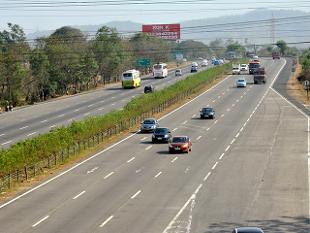
Maharashtra State Road Development Corporation – the nodal agency for the Rs 46,000-crore Mumbai Nagpur Expressway – is in talks with SBI Caps and lenders like State Bank of India (SBI) and IDBI Bank to fund the project, according to senior bankers and government officials. Reportedly, a host of sovereign wealth funds have also evinced interest in part-funding this project.
According to a banker, representatives from SBI caps and SBI met MSRDC officials early last week to discuss the proposal. Confirming the development, Radheshyam Mopalwar, vice-chairman and managing director, MSRDC said that it has sent the proposal to government and is awaiting approval. “SBI caps is proposing to be the arranger and will bring in seven to eight banks on board. They are already in discussions. Now we will soon officially sign up with SBI Caps,” he explained but declined to disclose the names of interested foreign investors.
SBI Caps recently informed MSRDC that foreign investors are interested in the project. Mopalwar said due diligence for the project would be conducted by the likes of KPMG, E&Y, etc. and they would in turn rope in the likes of Cyril Amarchand Mangaldas, etc.
“We require $4 billion. Our engineering cost is around Rs 27,000 crore and SBI Caps is giving some indicative figures what they can get us from the domestic market but let’s see what the exact amount is,” Mopalwar said.
The Nagpur-Mumbai Expressway, also called the Maharashtra Samruddhi Corridor is the first project in Maharashtra being set up by pooling land rather than by acquiring it. “This is the first effort to get into partnership with the farmers, wherein we are giving them developed land more than even what a real estate developer would offer. Since, the land being offered is along the 24 inter-changes planned along the highway, the value realisation of the land on completion of the project will be exponentially higher,” Mopalwar had earlier said.
The proposed prosperity greenfield corridor between two major cities of Nagpur and Mumbai will be a 710-kilometre long four-lane super fast expressway. It will cut the distance which presently takes up to 16 hours to just 8 hours. The expressway will run through 10 districts, 22 talukas and 345 villages. However, the benefits will spill over to as many as 27 districts since other areas too will be connected to the main road.
Indian start-ups to double by 2020: Nasscom
November 4, 2016

The start-up ecosystem in the country is expected to double in the next few years and could cross the 10,000 mark, a recent report by Nasscom said. The report which allayed concerns of a slowdown in the Indian start-up activity said the country continues to the third largest base for start ups globally.
The Nasscom- Zinnov report titled “Indian Startup Ecosystem Maturing – 2016” which was released recently said the ecosystem is poised to grow by an impressive 2.2 times to reach more than 10,500 startups by 2020, employing over 2,10,000 people. The report finds that Bengaluru, NCR, and Mumbai continue to lead as the major start-up hubs in the country.
According to the report, the number of tech start-ups in India is expected to grow by 10-12 per cent to over 4,750 by the end of 2016. The report further said that there is a 40 per cent increase in the number of active incubators and accelerators in 2016 with impetus from government and the corporate sector.
Over 30 new academic incubators have been established under the government’s ‘Start-up India Stand-up India’ initiative this year, and tier-II/III cities have established 66 per cent of the new incubators, the report said.
So far as investments are concerned, the report said that investors are increasingly looking at opportunities in start—ups in areas other than online retailing. Ventures in Fintech, Healthtech, Edutech, data analytics, B2B commerce and artificial intelligence, are seeing interest, according to the report.
SBI inks pact with IIT-Kharagpur for fintech innovation
November 4, 2016
State Bank of India (SBI) – the country’s largest lender which has been on the forefront of technological innovation among state-run banks – has decided to collaborate with the prestigious Indian Institute of Technology, Kharagpur, for promoting innovation and collaboration with fin-tech companies.
The wider programme includes ideation, incubation, experimentation and commercialization of new technology driven products and services for the banking sector. IIT Kharagpur, one of the premier technology institutes of the country and having a number of initiatives for spotting, incubating, setting and channelizing new technology ideas and start-ups, has been taking collaborative steps with industries to further the national cause of “Make in India” and “Start-up India”.
These institutions of national importance have come together to bring the benefits of synergy and complement each others’ capabilities for innovation and fin-tech for the benefit of every Indian citizen. For this purpose, an MOU was signed between the State Bank of India and IIT Kharagpur at Mumbai, delineating a broader road-map of detailed cooperation, SBI said in a statement. “The action plan includes collaborative research, Centre of Excellence (CoE) and running proof of concepts in various areas,” it added.
Supreme Court refuses to stay Allahabad HC order of making DND fly-way toll-free
November 4, 2016
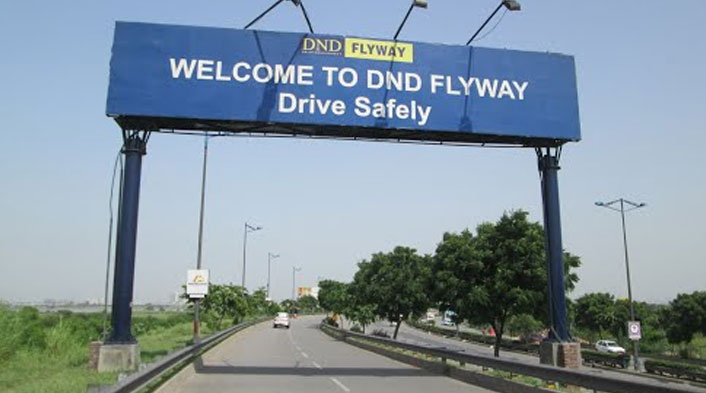
The Supreme Court has refused to stay the Allahabad High Court order which made DND (Delhi-Noida-Direct) toll free. The apex court said no toll should be collected until further orders.
Following a public litigation interest (PIL) filed by Federation of Noida Residents’ Welfare Association in 2012, the Allahabad High Court, last week, ruled that no user fee can be collected by the private concessionaire from the commuters of the 9.2 km-long, eight-way flyover that connects New Delhi, the capital city of India, to Noida and its neighbourhood. The PIL had challenged the levy and collection of toll by Noida Toll Bridge Company any further as it argued the company has already made sufficient profit.
The Noida Toll Bridge Company Ltd – which operates the toll way – filed a plea in the Supreme Court against the Allahabad High Court’s order. Noida Toll Bridge Company had asked the apex court to get its accounts audited by CAG. The court said the accounts of DND toll company will be audited either by Comptroller and Auditor General (CAG) or by an independent auditor to find whether the profit recovered was adequate.
The Supreme Court will pass an order on November 7 about auditing the account and till the audit report is submitted, there will be no toll on the expressway, an SC bench comprising justices AR Dave, RK Agrawal and AM Khanwilkar said. The toll for the fly-way, opened in February 2001, was Rs 8 initially but it was gradually hiked to Rs 28 per trip. About 1.5 lakh vehicles use the DND fly-way on a weekday.
An analysis by CRISIL on the pace of road construction
October 26, 2016
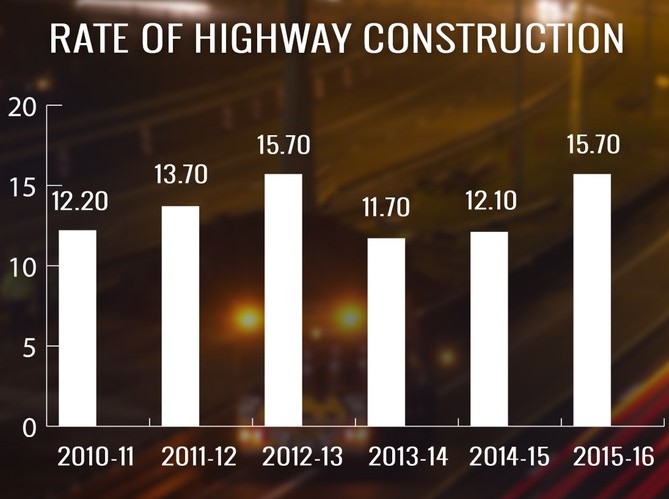 Info source : Lok Sabha and Rajya Sabha
Annual highway construction
Year Distance
2011-12 2207 km
2012-13 2481 km
2013-14 1628 km
2014-15 1576 km
2015-16 2196 km
2016-17P 3040 km
2017-18P 4242 km
Pace of execution improves
8 months post awarding 12 months post awarding 18 months 30 months
2012-13 2% 3% 3% 41%
2013-14 9% 18% 39%
2014-15 5% 24%
Road projects : Full speed ahead
The speed of execution of projects awarded by the National Highways Authority of India (NHAI) improved 40% from an average 4.3 km per day in fiscal 2015 to 6 km in fiscal 2016. The material improvement in the pace of execution can be attributed to policy reforms by NHAI and facilitations by the government which are also reducing delays. The pace of execution is now expected to nearly double to over 11 km by fiscal 2018, propelled partly by execution of engineering, procurement, construction (EPC) projects awarded in the past three fiscals, according to research firm CRISIL.
However, even in the case of build, operate, transfer (BOT) and stuck projects, there has been some positive movement. For example, 15 NHAI projects were completed in the first four months of the current fiscal of which seven were BOT toll projects and four were awarded prior to 2009. CRISIL also analysed disaggregated data on execution for all projects awarded by NHAI during fiscals 2013, 2014 and 2015 at eight, 12, 18, and 30 months after awarding. Here too, the prognosis is encouraging with close to 25% execution taking place 12 months after projects were awarded in fiscal 2015.
The pace of execution of BOT projects awarded in fiscal 2013 has also ramped up to around 40%, 30 months since.
The key policy reforms initiated include easing of the clearances process, ensuring 80% land acquisition before the award of project, premium rescheduling, allowing developers to fully exit operational road projects, and introduction of the hybrid annuity model. Given that these reforms are largely aimed at reducing risk, CRISIL believes that private participation is set to pick up. Nonetheless, while the situation appears to be improving, there are still several BOT projects awarded between fiscals 2010 and 2012 that continue to be delayed, and are consequently viewed as high-risk projects.
Mumbai University gives way for better connectivity at BKC
October 26, 2016
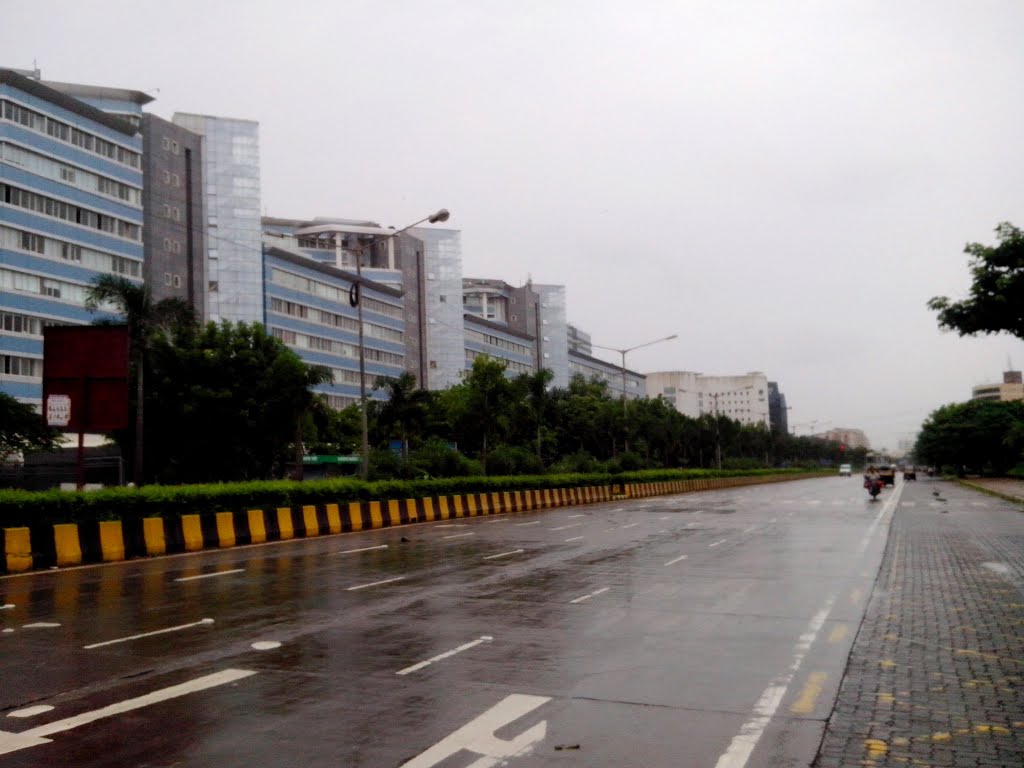
MMRDA draws up elaborate plan to ease traffic movement around the business district
The University of Mumbai has decided to hand over 34,715 sq. meters of land to Mumbai Metropolitan Regional Development Authority (MMRDA) which will be used for de-congesting the area around the important business district of the city – the Bandra Kurla Complex (BKC). MMRDA will be constructing a 1.2-km long elevated road with 2+2 lanes from Bharat Diamond Bourse Junction in BKC to Vakola Junction near Western Express Highway (WEH). For the purpose, Mumbai University will hand over a land measuring18,834 sq. meters to MMRDA.
MMRDA will construct a 400-m long and 30-m wide road in the vicinity of Mumbai University for additional connectivity from BKC to Santa Cruz Link Road (SCLR). For the purpose, Mumbai University will hand over a piece of land measuring 15,881 sq. meters to MMRDA.
The transfer and development (TDR), generated after handing over of the land to MMRDA, will be sold and used for the overall development of Mumbai University which will include construction of hostels, staff quarters, guest houses, science block, etc. in an area of 3 lakh sq. meters approximately.
A joint statement was issued by UPS Madan, Metropolitan Commissioner, MMRDA and Sanjay Deshmukh, Vice Chancellor, Mumbai University on the issue. The statement said, MMRDA, in its pursuit to provide better connectivity to ever developing BKC, is constructing a few flyovers such as the one from Bandra-Worli Sea Link to BKC, which is aimed at providing signal-free traffic from the Sea Link (from the Mahim Causeway side) all the way up to BKC, and a similar one from BKC to Sea Link.
“In addition, there will be a road on stilts from Kalanagar towards Sea Link, which will cater to the traffic from Sion/Dharavi,” the statement said. The estimated cost of the work will be Rs 253 crore.
Debit card scare: A lesson for banks and their customers
October 24, 2016

Debit card data pilferage – security breach or just plain human error ?
One of the biggest cases of suspected debit card data, that was compromised, highlights the importance of a key issue in the financial sector – customer education. The importance of customer education is becoming increasingly indispensable in this financial environment characterised by cutting-edge technologies and product and process innovation. While there are occasional reports of fraud in automated teller machines (ATM) that make it to the brief columns in newspapers, the recent case made headlines as the magnitude of the scare was significantly larger.
Data is suspected to be compromised of around 32.5 million debit cards which were used for transactions in 90 odd ATMs of a particular bank located across the country. According to the National Payments Corporation of India (NCPI), the home-grown payments gateway – the problem came to light after the receipt of complaints from a few banks that their customers’ cards were used fraudulently, mainly in China and USA while the customers themselves were in India. Apprehending that this could be a case of card data compromise, all the ATMs/PoS terminals in India and three card networks – RuPay, Visa and MasterCard worked in a collaborative manner in the month of September 2016.
It was found that the complaints of this fraudulent withdrawal were limited to cards of 19 banks and 641 customers. The total amount involved is Rs 1.3 crore as reported by various affected banks to the NPCI. The fact that the number of complaints were limited is mainly due to the fact that about 50 per cent of the banks’ customers do not have their account numbers linked to their mobile phone numbers. As a result, they did not receive any alerts when a transaction was made. Furthermore, when banks did start alerting them to change their pin, this communication was also not received by them. As a result, some banks like State Bank of India decided to block the cards and issue new cards, which is of course an added cost to them.
This is despite the Reserve Bank of India (RBI) issuing a circular about two years back asking banks and customers to get their mobile numbers registered and that the banks should alert their customers for every transaction. Moreover, even if the customers’ mobile number is registered with the bank, sometimes the bank only sends alerts if the value of the transaction is more than a particular threshold, say Rs 1,000 or Rs 10,000. This varies from bank to bank. This is against the spirit of the RBI guidelines. RBI norms clearly say that if a bank wishes to, it can charge the customers for the SMS alert service. However, some banks are not charging but at the same time, not sending SMS alerts for each and every transaction.
What is a Smart City ?
October 20, 2016
Deepak Premnarayen, President, Indian Merchants Chamber, Chairman FirstRand Bank India/ Non-Executive Director, FirstRand Global Board South Africa, expands on his idea of smart cities for India.
Excerpts from an interview :
Chandigarh, Nagpur and Pondicherry have been chosen by the French for adoption as they want to focus on these cities in India to develop them into smart cities. What do you think are the attractiveness of these cities? Would you say they are relatively better placed in terms of their infrastructure as compared to other cities in India?
Cities are chosen based on the survey and contest which included parameters like extent of citizens’ engagement and participation, strategic planning for the city, vision and goals, amongst others.
Each of the above cities is unique. Chandigarh has a French connection as it was designed by Le Corbusier – a French architect who worked on a new city in 1960s. It was and is a model city in terms of layout, the scope of expansion to absorb growth, its strong regional economic base. Nagpur is another city, has tremendous scope and opportunities of expansion for domestic and industrial requirements. Pondicherry – being an ex- French colony and historical connections – also comes under the above charterstics to be developed as a smart city.
Cities, if they have to become smart, have to be compact structures which support innovation in public transportation, use of smart technologies to manage power, infrastructure, and public safety, recycle water and manage work places with quality of life being enjoyable.
China, which saw huge growth rates continuously over two decades, relied on making its cities smart to bear the burden of industrialisation and consequently of urbanisation, which is the key to growth
If India is to grow at impressive rates, there have to be a local model of development where there has to be a shift from agriculture to industrialisation, which has to be supported by new employment opportunities, rise in consumer demand, and related spending and adoption of new smart technologies to support smart cities.
The cities which have been chosen so far to be developed as smart cities, have a comparative advantage of being better placed with respect to civic amenities, high disposable incomes and opportunities for trade. Also, commerce and industrialisation opportunities are promising, all which are important points in favour of smart cities.
What is the definition of a smart city in the Indian context? Is there a particular model that India needs to look up to, like a French model or a model from any other part of the world?
Cities in India have to be planned as innovative industrial cities which create jobs, which raise the quality of living, which integrates cultural ethos and social fibre to make cities vibrant. In Indian context the smart city has three connotations:
- Green Field Smart City – where every initiative is taken afresh – right from planning, execution, technology, regulation and financing – all happening at a new level, with new ideas, and bringing new innovations.
- Redevelopment – where an old structure or set up in an existing geographical area or segment is built afresh. The most critical areas is undertaken for refurbishing. This model has limitation in terms of human resettlement and the extent of services that need to be redeveloped. In this the though innovative and modern contemporary technology is launched, the canvas is small.
- Retro fitment is a mechanism, where only a portion of the segment needs change. This is a piece meal type of a “smartness” being brought into a small segment of the city. The scope of introducing retro fitment – is vast and since it is less time consuming and working on limited budgets, many cities could be looking at this option.
India needs a fine combination of all the three “models “ depending on the extent and scope of demand for change. For example, seven new cities are planned along the Delhi Mumbai Industrial Corridor, as Smart cities. These could be developed on model of Green Field Smart City project, which offers an unlimited scope to implement new ideas in civic services – such as adoption of technology in managing novel transport arrangements, uninterrupted water supply, newer sanitation offerings, recycling of water and solid waste management, e governance, involving citizens engagements and ensuring their safety – amongst others. As many of the Indian cities are having historical lineages, redevelopment and retro fitment could also be the complementary solutions
What is it that is required to be done in India in order to achieve a standard of development and civic amenities that is so nicely done in the developed countries?
Innovative financing methods need to be looked at. As most of the corporations and municipalities have very limited resources of generating revenues themselves, they depend on the grant of state governments, which themselves are under heavy financial strain and deficits. This is a limiting factor for them to experiment with new technologies in civic administration and services as a contemporary with other sister cities across the global. Thus innovative ideas of PPP, venture capital financing, launching of municipal bonds or even Smart City Bonds could be considered.
Secondly the Municipal corporations have to be corporatized with a structure which is less bureaucratic and more performance oriented. The head of a Smart City can be a CEO brought in from the market with market driven experience in administering – both on managerial and technology capabilities.
Thirdly- Performance and Ranking Index could be developed for the Smart City / municipal corporations to attract investment, attract service providers and attract citizens to be part of this city. The rating criteria would be marked on the basis of in diverse parameters such a quality factor of air and water, employment opportunities, civic amenities, quality of infrastructure etc.
Featured Insights
- Gurugram: Hero Honda chowk to not choke anymore as Delhi-Jaipur flyover set to open soon
- Future of extensive Smart City projects uncertain
- Financiers express interest for Mumbai-Nagpur super expressway
- Indian start-ups to double by 2020: Nasscom
- SBI inks pact with IIT-Kharagpur for fintech innovation
- Supreme Court refuses to stay Allahabad HC order of making DND fly-way toll-free
- An analysis by CRISIL on the pace of road construction
- Mumbai University gives way for better connectivity at BKC
- Debit card scare: A lesson for banks and their customers
- What is a Smart City ?
The ITW Team
 Sachin Bhatia Chief Editor |


Leisure
E-Z Pass Only
Improved Car Seat Belt 40% Less Accidents

NHAI's First ETC(Electronic Toll Collection) PLAZA
- ETC based on Microwave Technology(CEN 278) implemented at Delhi - Gurgaon Super Connectivity
Technology by: -Kapsch Metro JV.
News Categories
- NHAI (332)
- Highway (233)
- BOT (231)
- Projects (207)
- Default (204)
- Road (182)
- About (175)
- Infrastructure (160)
- Tolling (108)
- Investment and Finance (102)
- Expressway (98)
- Construction (90)
- Smart City (87)
- NHDP (77)
- ITS (65)
- International (55)
- Delhi (53)
- Safety (53)
- Toll Plaza (51)
- Toll Management System (50)