Hybrid Annuity Model makes inroads into BOT projects
August 9, 2016

Roads of trouble
April 7, 2014
RAHUL PRITHIANI

Road developers are in a tizzy as both debt-servicing ability and returns of national highway projects have come under severe strain as the economics has gone haywire because of low traffic, execution delays and cost overruns.
Over the past couple of years, traffic growth on national highways has slid precipitously, in conjunction with the economy and industrial production. An analysis of traffic growth across 15 national highway projects that have been operational for over three years revealed that overall traffic growth, estimated at 7-8 per cent between fiscals 2008 and 2011, slumped to 3-4 per cent in 2012 and to 2-3 per cent in 2013. In fiscal 2014 too, the traffic growth has been weak due to sluggish economic activity.
The culprit was commercial vehicle traffic, whose slowdown overshadowed a healthy 15 per cent average growth in passenger vehicle traffic during this period.
Special purpose vehicles
This deteriorating trend is also mirrored in the revenues of a dozen special purpose vehicles (SPVs) operating under the build-operate-transfer (BOT) model. Revenues of these SPVs have grown by about 12 per cent in the past couple of years. During this period, toll rates rose by 8-9 per cent per annul as these are linked to the wholesale price . But poor traffic growth negated most of the benefits.
The scenario is unlikely to improve much in the near-term. Road traffic has high correlation with industrial growth . While we expect IIP to recover in fiscal 2015 to about 4 per cent from the decadal low of about 1 per cent it hit in fiscal 2014, it will remain well below the long-term average.
Consequently, commercial vehicle traffic growth will be lacklustere and overall traffic growth on national highways will languish at 3-5 per cent in fiscal 2015. As almost the entire operating costs in a road project are fixed in nature, any variation in the traffic, especially during initial years, has a significant bearing on the project returns.
Slow traffic growth on national highways is not the only problem plaguing developers. Base traffic (in the first year of a highway’s operation) has been much lower compared to the NHAI draft project report estimates. To be sure, developers would have done their own math on traffic, including expected leakages and exempt vehicles, before bidding, yet they will be concerned about how wide off the mark the original estimates were.
Compounding these problems for road developers are delays and the resultant cost overruns. Of the 78 BOT projects completed between fiscals 2000 and 2013, more than three-fourths or 61 projects faced delays, with the average time overrun at 10.5 months. The situation has only worsened in the last couple of years. Execution hasn’t begun for about 33 projects awarded in fiscal 2012 .
The double whammy of lesser-than-expected traffic and cost overruns has severely impaired the debt-repayment ability of developers. For five of these projects, the average debt-service coverage ratio during the first five years of operations is estimated to be less than one. This means equity infusion is essential to ensure timely servicing of debt, especially since tying up for additional debt will be difficult in the current scenario. Returns for these road projects are also expected to be 8-14 per cent, much lower than the 22-26 per cent returns based on NHAI traffic and cost estimates.
The above-mentioned scenario is representative of most road developers. Clearly, road developers are being buffeted by problems from all sides and have very limited room for manoeuvre. Recently, the government offered some respite by relaxing exit norms and allowing for premium deferment in the case of stressed projects. However, it might turn out to be a case of too little, too late.
The author is Director, Crisil Research, a division of Crisil
Source- http://www.thehindu.com/
IRB commences construction on Goa/Karnataka Border to Kundapur BOT Project
March 13, 2014
India Infoline News Service/
The company has also executed concession agreement with NHAI for another BOT project
IRB Infrastructure Developers Ltd (“IRB”), one of the largest BOT road developers in India, announced that it has commenced construction on Goa/Karnataka Border to Kundapur BOT Project. The company has also executed concession agreement with NHAI for another BOT project viz. Four Laning of Solapur to Yedeshi section of NH-211.
Goa/Karnataka Border to Kundapur BOT Project is being implemented by the wholly-owned subsidiary of the company viz. IRB Westcoast Tollway Pvt. Ltd. This SPV has now received an Appointed Date in terms of the Concession Agreement executed with NHAI. The project involves four laning of NH17 from Km 93.700 to Km 283.300 in the State of Karnataka. The project cost of the company is approximately Rs. 2,639 crores and the concession period is 28 years. Construction period for the project is 910 days. IRB has sought Rs. 536 crores as viability gap funding from NHAI. The SPV has already achieved financial closure and tied up project finance of Rs. 1,406 crores from a consortium of public sector banks.
IRB has also informed that it’s another wholly-owned subsidiary viz. Solapur Yedeshi Tollway Pvt. Ltd. has executed concession agreement with NHAI for the project of four laning of Solapur to Yedeshi section of NH-211 in Maharashtra. The estimated project cost is approximately Rs. 1,500 crores. IRB has sought Rs. 189 crores as viability gap funding from NHAI for the project. Concession period is 29 years for the project and construction period is 910 days.
Source –http://www.indiainfoline.com
Second thoughts on highway rescue
December 13, 2013
Rangarajan panel reviews proposals on premium restructuring & penalties after PlanCom advisor’s objections
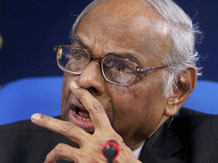
Road developers hoping for early relief from the government will have to wait longer.
A committee set up under C Rangarajan, chairman, Prime Minister’s Economic Advisory Council, is reworking its report on providing such relief, after concerns were raised by Gajendra Haldea, advisor, Planning Commission.
Last Friday, Haldea raised concerns on the proposed recommendations. The issues in question were the structure of premium rescheduling and the penalty norms, following which the committee sought more clarity from the roads ministry.
The key recommendations of the report include rescheduling the premium that companies owe to the National Highways Authority of India (NHAI) and fixing the interest payment on the deferred amount at 10.75 per cent. In addition, it felt no penalty should be charged on the developers.
Premium here is the amount NHAI concessionaires have to pay for a BoT (Build-Operate-Transfer) project, as the returns are expected to be high. It is usually decided on the basis of estimated future traffic flow at the time of bidding. The term for payment of the premium is usually 20 to 25 years and the amount payable ranges from Rs 3 crore to Rs 680 crore a year. The amount goes up yearly by five per cent, according to existing norms. NHAI is due to receive about Rs 151,000 crore over the next 20-25 years from private developers.
“The report was to be ready early this week. But, following a letter written by Haldea, Rangarajan has decided to study the concerns raised and we can expect final recommendations only in the next 10 days,” said a senior official in the roads ministry. Haldea confirmed he’d commented on the report but declined to disclose details.
The Rangarajan committee was set up this October. This was after a number of road developers threatened to walk out of projects due to the economy’s slowing. They’ve complained about inability to generate adequate revenue for repaying the premium. The committee had also proposed that the companies not be allowed to pay dividend to their parent companies until they cleared their dues to NHAI.
There was also a recommendation to allow private road developers to pay only 25 per cent of the premium they owed NHAI in the first three years. Companies were to raise this to half the amount due after three years. The sum carried forward was to attract an interest rate of 10.75 per cent.
“The trigger point for Haldea to raise the concern seems to be the absence of penalty. He does not want the companies to be given a breather and wants to overrule a cabinet decision which wanted projects to continue. If we do not allow this rescheduling, then we have to go in for re-bids. Given the current environment, we will not get any bidders,” the ministry official added.
The government has already cancelled a plan to award projects on public-private partnership during this financial year and is moving towards government-funded projects. The roads ministry plans to now award 5,000 kilometres this year under the engineering-procurement and construction mode this year, after the developers decided to stay away from bidding.
IRB Infra: On the road to recovery
November 20, 2013
Jitendra Kumar Gupta |

Better-than-expected numbers for the quarter ended September have turned analysts positive on IRB Infrastructure Developers, among India’s largest road construction and operating companies.
Both better execution of ongoing projects and strong growth in revenues from the BOT (build-operate-transfer) segment aided the performance. The growth momentum is expected to remain good, backed by revenues from the construction segment and the toll business, in which new projects will go on stream in the coming months.
Analysts believe valuations are reasonable and, therefore, there is room for appreciation. At Rs 90, the stock is trading at about five times its FY15 expected earnings and offers a dividend yield of 4.5 per cent, which is attractive considering the return on equity of about 18 per cent.
For the September quarter, IRB reported 11.1 per cent annual growth in revenues at Rs 939 crore and similar growth in operating profit at Rs 422 crore. The construction business, which accounted for 71 per cent of the consolidated revenues, recorded 11 per cent year-on-year growth, aided by better execution in the case of projects such as the Ahmedabad-Vadodara, Pathankot-Amritsar and Jaipur-Deoli ones. The company’s BOT revenues increased eight per cent, largely aided by new projects going on stream, which added to toll collections. Existing projects saw a slowdown in traffic, reflecting various economic woes, especially the fall in mining activity.
“Growth has certainly slowed, but with geographical advantages, we are still able to show good growth. For instance, the Surat-Dahisar and Mumbai-Pune projects, which account for 70 per cent of the toll collections, have seen traffic growth of about five per cent,” said chairman and managing Director Virendra D Mhaiskar.
While a recovery isn’t likely soon, given the tapering industrial and economic growth, analysts are hopeful. “Despite near-term concerns, we believe IRB is one of the best plays in India’s infrastructure story, with a stable balance sheet, high operating cash flow and a matured road portfolio,” said Mangesh Bhadang, who tracks the company at Quant Global Research.

Part of the concerns will be eased if the company sustains the pace of execution and adds more projects to its portfolio. It has already started toll collection in the case of the Jaipur-Deoli and IRDP Kolhapur projects, while the Amritsar-Pathankot project is expected to be commissioned by December.
Incrementally, these projects will add to the overall toll collections in the coming months and support growth. That apart, the company is sitting on an order book of Rs 5,053 crore, 1.85 times its FY13 construction revenue, providing medium-term revenue visibilities. This provides some relief, given the industry is going through a difficult phase because of the slowdown in project-awarding, the coming elections, lower traffic growth, execution issues and funding.
“Projects have been stuck for different reasons but now, reforms are taking place. Things have (been) delayed for 18-20 months. But again, since more clarity is emerging, the process of bidding will commence soon,” said Mhaiskar.
When the situation improves, IRB is well equipped to grab the opportunity, given its strong balance sheet and expertise in the business. From FY14, the company is expected to generate operating cash of Rs 1,000 crore annually, against Rs 945 crore in FY13. With such cash flows and assuming a 70:30 debt-equity ratio, the company can fund projects worth Rs 3,000-3,500 crore every year.
| In Rs cr | FY2013 | FY2014E | FY2015E |
| Net sales | 3,687 | 3,772 | 4,191 |
| % change | 17.7 | 2.3 | 11.1 |
| Adj.Net profit | 557 | 485 | 502 |
| % change | 12.2 | -12.9 | 3.5 |
| EBITDA (%) | 44.3 | 45.1 | 45.3 |
| EPS (Rs) | 16.7 | 14.6 | 15.1 |
| P/E (X) | 5.3 | 6.1 | 5.9 |
| P/BV (X) | 0.9 | 0.8 | 0.7 |
| RoE (%) | 18.2 | 14.2 | 13.4 |
| OB*/sales (x) | 2.4 | 3.1 | 3.5 |
| Order inflows | 2,595 | 3,384 | 3,574 |
| % chg | 30.4 | 5.6 | |
| Source: Angel Broking, * denotes order book | |||
Bus terminus to come up at Gandhinagar
October 28, 2013
TNN |
The KMT is hoping to generate about Rs 1.25 crore per year from renting the shops in the commercial complex. “We can procure about 20 new buses from the revenue generated. The land at Gandhinagar is owned by the KMT and local traders had demanded to set up a bus terminus in the area. The total estimated cost of the project is Rs 1.77 crore, which has to be invested by the contractor and the work is expected to be completed in two years after the tender is issued,” said KMT additional engineer Sanjay Bhosale. The area of the land on which the bus terminus will be constructed measures 423.50 square metres.
Gandhinagar, situated 5km from the city, is famous for its trading centres for cloth. “Efforts to construct a bus terminus at Gandhinagar were started in 1999. However, the plan was stalled due to unknown reasons. The demand to start a bus terminus in the area increased with a rise in the population and a subsequent rise in the number of passengers. About 15,000 people travel from Gandhinagar to various parts of the city every day. The KMT will arrange for direct buses from Gandhinagar to different points in the city once the terminus becomes operational,” added Bhosale.
PIL seeks inquiry in road development project
October 21, 2013
TNN |
KOLHAPUR: City-based social activist Subhash Vani has filed a public interest litigation (PIL) in the Bombay high court seeking a thorough inquiry into the work as part of the Kolhapur Integrated Road Development Project (KIRDP) and the land leased to the IRB Company.The high court will on Monday hear the PIL, which will be clubbed with a writ petition filed by the IRB Company seeking police protection for collection of toll. The PIL seeks an inquiry into the cost escalation of the project, which has gone up to Rs 512 crore from Rs 220 crore at the time of the agreement.Vani said, “There should be an probe into the quality of the roads and the pending work. We have also raised the issue of the policy of the build-operate-transfer (BOT) which we believe has failed across the state. Our demand is that the BOT policy should be suspended by the state government.”
He added that as per the agreement, the IRB Company will be allowed to collect toll for 30 years. The developer company may demand extension of the toll collection for a few years to recover the additional money it claims to have invested, he claimed.
Kolhapur was the first city in the state where the Maharashtra Road Development Corporation ( MSRDC) decided to experiment collection of toll on a public-private-partnership basis for an intra-city road development.
On the other hand, city-based communist leader Govind Pansare alleged that there were many flaws while drafting the project proposal and its implementation by the IRB Company. The KMC has leased out the land of about three lakh sq ft at Temblaiwadi in the city at an annual rent of Re 1 since 2009. The IRB leased out the land to a private hospitality firm, which is now constructing the luxurious hotel at the site, he said.
“The developer company has leased out the land given by Kolhapur Municipal Corporation to a hospitality company without taking the requisite permissions from the civic body. We want all these matters to be discussed in the high court and demand a CBI probe. Strict action should be taken against those found guilty,” Pansare told mediapersons.
Roads: clearing obstacles will take time
October 15, 2013
Vatsala Kamat

(The government’s desire to give a push to infrastructure projects may result in some relief from the problems of poor order inflows and low financial viability of existing projects. Photo: Ramesh Pathania/Mint)
Last week’s decision by the government to reschedule the premium payable by developers to the National Highways Authority of India (NHAI) is aimed at giving jammed road projects a new lease of life. The decision to reschedule the premium arose out of the fact that many developers quoted a hefty premium to win orders, as competition increased between fiscal years 2012 and 2013, which led to some projects turning financially unviable.
No doubt, the decision to reschedule will not change the profile of projects overnight. Analysts’ data indicates that more than 80% of the build-operate-transfer (BOT) projects awarded in fiscals 2012 and 2013 have not started construction yet. It is now widely known that land acquisition and environmental clearances, highly leveraged balance sheets, poor cash flows on existing projects and high interest rates are key reasons for a slowdown in the roads sector.
Around 23 projects caught in a quagmire will be examined on a case-to-case basis. However, a note by Citi Research says that one of the conditions to ensure smooth payments by developers after rescheduling is that the firms should furnish bank guarantees. “Given the tightening lending standards to road projects and leveraged balance sheet of developers, it may be difficult to furnish the bank guarantee,” it says.
As has been the case during the past several quarters, the September quarter too will see earnings of most infrastructure firms including roads being weighed down by high interest and depreciation costs. A report by IDBI Capital Market Services Ltd expects companies such as Hindustan Construction Co. Ltdand IVRCL Ltd to be in the red during the September quarter. And, others such as Simplex Infrastructures Ltd, Nagarjuna Construction Co. Ltd and IRB Infrastructures Developers Ltd are likely to see a decline in earnings compared to the year-ago period. Revenue expansion is likely in some cases where execution is on track.
But analysts’ data reveals that against a normal road completion time of 48 months, most projects awarded in fiscal 2009-10 are complete to the extent of only 50-60%.
Complicating the imbroglio is the fall in order inflows, which could get worse in the near term, given that elections typically see major decisions being postponed. This would stymie revenue expansion too. This fiscal year till date, NHAI has awarded only 479km of road projects costing Rs.2,700 crore, compared to the road ministry’s target of 5,000km of both EPC and BOT projects. EPC stands for engineering, procurement and construction.
Now, the orders that have already been given can mean healthy order book for some firms, giving decent revenue visibility for the next one or two years. Among the mid-sized firms, Sadbhav Engineering Ltd and Ashok Buildcon Ltd are better off than some of their peers.
The government’s desire to give a push to infrastructure projects may result in some relief from the problems of poor order inflows and low financial viability of existing projects. But the pace leaves a lot to be desired and it may be many more quarters before actual and substantial movement is visible. For now, nothing seems to have changed for the roads sector.
The mega road bailout – Rewarding corporate greed?
October 7, 2013
Nikhil Inamdar | Mumbai

When GMR wriggled out of a highway project for which it had paid a whopping Rs 636 Cr as premium, seeking a renegotiation of terms with NHAI last year, 2 notes of dissent from the Finance Ministry and the Planning Commission observed the following –
“Varying the payment schedule at this stage implies departure from a legally binding contract, an action that cannot be supported” – RS Gujaral, Finance Secretary
“Such whimsical changes in legally binding contracts is a poor reflection on the credibility of government and its agencies” – Sindhushree Khullar, Plan Panel Secretary
Gujaral’s note also expressed unease about this becoming a precedent for other contracts in similar distress.
His words must be ringing loud in the ears of road ministry officials today as the government sets to pick up the tab for a staggering Rs 1.5 lakh crore to bail out private developers, if a proposal mooted by the ministry goes through. A Business Standard report (read here) reveals that a total of 39 projects are likely be approved under this plan, which will entail rescheduling of premium payments to NHAI. Projects include ones bagged by marquee names like Larsen & Tubro, Ashoka Buildcon and IDFC among others.
Premium is the amount paid by a concessionaire to NHAI during the bidding of BOT (build-operate-transfer) projects which are expected to give very high returns. In the good times, when liquidity was abundant, corporate balance sheets were in the pink of health, India was growing at 9% and there was a slugfest among bidders for bagging lucrative contracts – private developers threw caution to the winds and paid hyper aggressive premiums for projects. They based their calculations on brash projections of future traffic growth, reflecting the audaciousness that’s often seen in a booming economy.
But as growth plummeted, that swagger evaporated, and traffic projections went out of whack (by as much as 45% on the down side in some cases according to Fitch) developers are being seen queuing up at the government’s doorstep for help, with the ministry more than willing to oblige, no matter that its own fiscal situation is more precarious than ever.
Think of what would have happened in a reverse scenario. Would the concessionaire have agreed to a revision of terms had profits zoomed higher than projected? Clearly not!
But the argument of the ministry seems to be that inaction will shake up the entire road sector and have a cascading impact on the rest of the economy, so this is the best way out of the mess. Experts agree.
“In this first phase of PPP in the last 15 years, there have been huge learnings for both the government and the private sector. While developers miscalculated projections, there were many things that the government did wrong as well, so I would argue for a one time reset and insist that policy be framed clearly and transparently” says Vinayak Chatterjee, Chairman of Feedback Infrastructure.
Government sources insist that it is a ‘one-time relief’ proposal indeed, and not a policy. But relief for some means a lost opportunity for others (companies that lost out on the bids because of undue aggression by winners) and an easy way out for the barrage of non-serious players who had entered this business to make a quick buck.
A more rigorous approach to this ‘reset’ could have entailed measuring the depth of stress of each developer minutely and granting only those genuinely unable to cough up the cash, a chance at premium renegotiation. But experts feel that would be impractical and also led to potential litigation for being discriminatory in nature.
Whatever be the satisfactory solution to this quagmire, what’s clear is that across the infrastructure arena, PPP projects have been battling similar issues – be it with the UMPPs (Ultra Mega Power Projects) in the power sector, or the entire gas pricing debate in the petroleum space. In each of the cases, whether it’s Adani and Tata with regards to higher compensatory tariffs for UMPPs, or Reliance Industries which would benefit from the Rangarajan formula – it is the developers who’ve gotten away relatively unscathed, despite a glaring divergence in what they’ve promised, and what they’ve actually been able to deliver. The government meanwhile, has been left with no choice but the renegotiate contract terms and conditions keeping the larger good of the economy in mind.
Having presumably learnt from these failures, the hope now is that phase II of PPP in India will be less thorny.
NCC Limited to sell BOT assets to reduce debt
September 11, 2013
Prashanth Chintala |
NCCL is also reported to have decided to exit from the two joint venture power projects in which it had made investments
Hyderabad-based NCC Limited (NCCL) has decided to sell some of its build, operate and transfer (BOT) assets and other properties, including land parcels, to bring down debt on the company’s books.
The BOT assets of the infrastructure development company include five road projects, which have commenced commercial operations.
“We are looking at a strategic sale of two road projects and some real estate assets to reduce our debt, which is to the tune of Rs 2,225 crore,” company’s executive vice president (finance), YD Murthy, told Business Standard.
He said the company was currently holding discussions with potential buyers for the sale of two toll projects located in western Uttar Pradesh and Karnataka. He was expecting the sale proceeds would be Rs 200-250 crore.
NCCL is also reported to have decided to exit from the two joint venture power projects in which it had made investments. While it is stated to have sold a 5 per cent stake in the 100-Mw Himachal Sorang Power Limited, discussions are being held with interested company’s for a stake sale in the 1,320-Mw coal fire project at Krishnapatnam in Andhra Pradesh.
According NCCL managing director AAV Ranga Raju, the company expects a 10-15 per cent growth in both order book and topline in 2013-14. It had already received fresh order of Rs 4,814 crore.
NCC had achieved a consolidated turnover of Rs 7,059 crore and a net profit of Rs 56.38 crore in 2012-13. Finance costs during the year stood at Rs 595 crore.
Despite the challenging environment, Raju stated in NCC’s annual report that the company registered a 9 per cent rise in topline last year due to a reduction in establishment expenses and improvement in project execution and collections.
In the current financial year, NCC reported a 71 per cent decline in its net profit to Rs 5.8 crore for the first quarter as compared with a profit of Rs 20.33 crore in the corresponding quarter last year.
Featured Insights
- Gurugram: Hero Honda chowk to not choke anymore as Delhi-Jaipur flyover set to open soon
- Future of extensive Smart City projects uncertain
- Financiers express interest for Mumbai-Nagpur super expressway
- Indian start-ups to double by 2020: Nasscom
- SBI inks pact with IIT-Kharagpur for fintech innovation
- Supreme Court refuses to stay Allahabad HC order of making DND fly-way toll-free
- An analysis by CRISIL on the pace of road construction
- Mumbai University gives way for better connectivity at BKC
- Debit card scare: A lesson for banks and their customers
- What is a Smart City ?

The ITW Team
 Sachin Bhatia Chief Editor |


Leisure
E-Z Pass Only
Improved Car Seat Belt 40% Less Accidents

NHAI's First ETC(Electronic Toll Collection) PLAZA
- ETC based on Microwave Technology(CEN 278) implemented at Delhi - Gurgaon Super Connectivity
Technology by: -Kapsch Metro JV.
News Categories
- NHAI (184)
- Highway (63)
- BOT (71)
- Projects (61)
- Default (204)
- Road (43)
- About (175)
- Infrastructure (26)
- Tolling (5)
- Investment and Finance (102)
- Expressway (40)
- Construction (15)
- Smart City (87)
- NHDP (33)
- ITS (21)
- Delhi (32)
- Safety (14)
- Toll Plaza (12)
- Toll Management System (2)
- Metro Rail (42)